

Sanitary Tee H x H x H
(40) A hub ended fitting that easily provides a directional transition between vertical and horizontal.- When tested to the CAN/ULC S102.2 Standard, System XFR achieved a Flame Spread Rating of not greater than 25 and a Smoke Developed Classification of not greater than 50
- Meets National and Provincial Building Codes for high buildings, air plenums, noncombustible construction and penetrating a rate fire separation
- High impact strength in cold temperatures, exceeding CSA requirements
- Improved flow rates
- Lower thermal conductivity can reduce or eliminate the need for insulation

Sanitary Tee Sp x H x H
(3) A hub ended fitting that easily provides a directional transition between vertical and horizontal.- When tested to the CAN/ULC S102.2 Standard, System XFR achieved a Flame Spread Rating of not greater than 25 and a Smoke Developed Classification of not greater than 50
- Meets National and Provincial Building Codes for high buildings, air plenums, noncombustible construction and penetrating a rate fire separation
- High impact strength in cold temperatures, exceeding CSA requirements
- Improved flow rates
- Lower thermal conductivity can reduce or eliminate the need for insulation
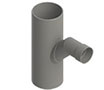
Sanitary Tee Sp x Sp x H
(6) A hub ended fitting that easily provides a directional transition between vertical and horizontal.- When tested to the CAN/ULC S102.2 Standard, System XFR achieved a Flame Spread Rating of not greater than 25 and a Smoke Developed Classification of not greater than 50
- Meets National and Provincial Building Codes for high buildings, air plenums, noncombustible construction and penetrating a rate fire separation
- High impact strength in cold temperatures, exceeding CSA requirements
- Improved flow rates
- Lower thermal conductivity can reduce or eliminate the need for insulation
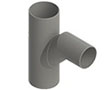
Sanitary Tee Sp x Sp x Sp
(6) A hub ended fitting that easily provides a directional transition between vertical and horizontal.- When tested to the CAN/ULC S102.2 Standard, System XFR achieved a Flame Spread Rating of not greater than 25 and a Smoke Developed Classification of not greater than 50
- Meets National and Provincial Building Codes for high buildings, air plenums, noncombustible construction and penetrating a rate fire separation
- High impact strength in cold temperatures, exceeding CSA requirements
- Improved flow rates
- Lower thermal conductivity can reduce or eliminate the need for insulation

Double Sanitary Tee H x H x H x H
(6) A hub ended fitting that easily provides a directional transition between vertical and horizontal.- When tested to the CAN/ULC S102.2 Standard, System XFR achieved a Flame Spread Rating of not greater than 25 and a Smoke Developed Classification of not greater than 50
- Meets National and Provincial Building Codes for high buildings, air plenums, noncombustible construction and penetrating a rate fire separation
- High impact strength in cold temperatures, exceeding CSA requirements
- Improved flow rates
- Lower thermal conductivity can reduce or eliminate the need for insulation

Sanitary Tee Side Inlet (left hand) H x H x H x H SI
(2) A hub ended fitting that easily provides a directional transition between vertical and horizontal.- When tested to the CAN/ULC S102.2 Standard, System XFR achieved a Flame Spread Rating of not greater than 25 and a Smoke Developed Classification of not greater than 50
- Meets National and Provincial Building Codes for high buildings, air plenums, noncombustible construction and penetrating a rate fire separation
- High impact strength in cold temperatures, exceeding CSA requirements
- Improved flow rates
- Lower thermal conductivity can reduce or eliminate the need for insulation

Sanitary Tee Side Inlet (right hand) H x H x H x H SI
(2) A hub ended fitting that easily provides a directional transition between vertical and horizontal.- When tested to the CAN/ULC S102.2 Standard, System XFR achieved a Flame Spread Rating of not greater than 25 and a Smoke Developed Classification of not greater than 50
- Meets National and Provincial Building Codes for high buildings, air plenums, noncombustible construction and penetrating a rate fire separation
- High impact strength in cold temperatures, exceeding CSA requirements
- Improved flow rates
- Lower thermal conductivity can reduce or eliminate the need for insulation